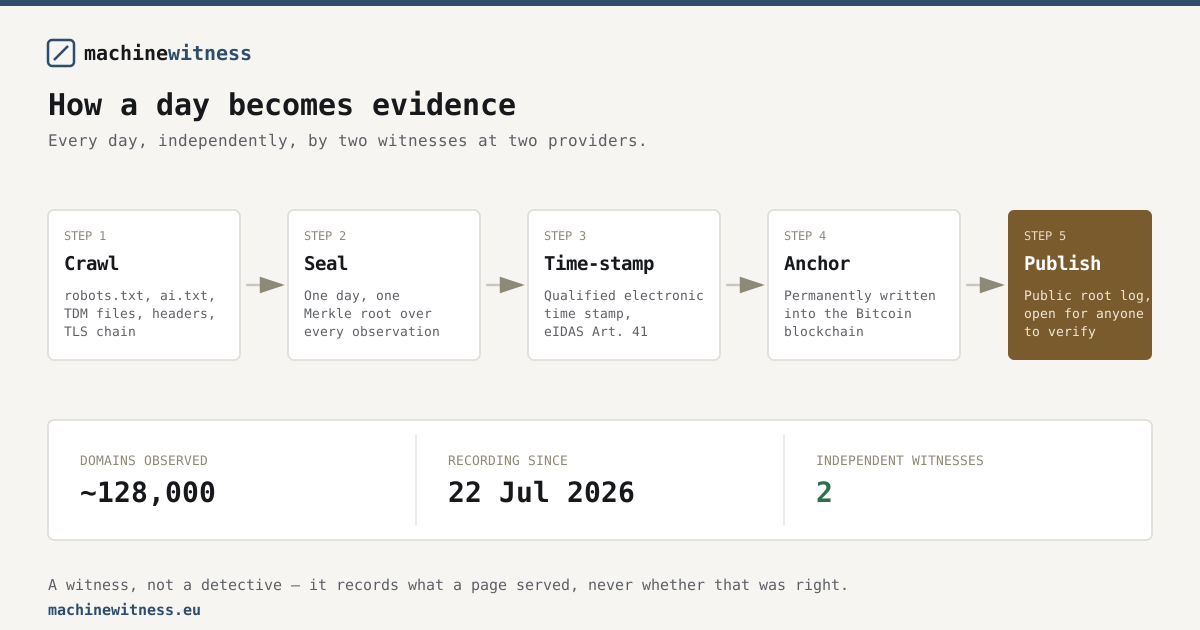
If you have not seen this archive before: since 22 July 2026, two independently operated machines have recorded, every day, what around 128,000 EU domains serve to machines and to visitors, sealed each day so nobody can alter it afterwards. What you buy here is not the archive itself. The record and the way to check it are free. What you buy is a document drawn from it: a domain added to what is watched daily, or a dated extract of what is already recorded, in a form you can file.
The legal weight sits with step 3: a qualified electronic time stamp under EU law (eIDAS, Article 41), which carries a statutory presumption of accuracy. Step 4, the Bitcoin anchor, adds a second, independent check that survives even if the time-stamp provider someday does not.
This archive records; it does not rate, rank or advise. Every fee is fixed, published here, and the same for whoever asks.
The admission is the premium. The extract is the claim.
You pay once so that the evidence exists. You pay again only if you ever need to hold it in your hand. Most of the domains recorded here will never be the subject of an extract, and that is not a flaw in the model. It is the model.
What follows is ordered by how a fee behaves over time, because that is the whole of the pricing rule: what lasts is paid for once, what takes work every night is paid for yearly, and a document is paid for per copy.
Once, and then without end
Around 128,000 EU domains are already recorded every day by reach alone. Admission moves a domain from that broad set into the curated core: its front page in full instead of weekly and capped, and the four machine-readable files, every day, from both witnesses. It is paid once. Nothing is invoiced again, ever, and no renewal can lapse.
You name one domain or a list of them, your own or another's. Within five working days of payment each is admitted to the core, on both witnesses, with a dated entry in the public record. From that day it is retrieved and sealed daily, for as long as this archive runs, with no further payment of any kind. The fee is charged per started block of twenty domains, so twelve domains cost the same as one, and twenty-one cost two blocks.
ExampleThe reservation that was there all along
A trade publisher puts an AI reservation into its robots.txt in May. Nine months later a model turns out to reproduce its articles almost verbatim, and the operator's answer is that nothing of the sort was declared at the time the crawl ran.
The publisher can show what the file says today. What it said in May sits on its own server, where the publisher itself could have changed it, which is precisely what the other side will say. Under a daily record the May file exists as bytes, sealed the same night by two machines at two providers and time-stamped under eIDAS, before anybody knew it would matter.
Publishers · rights holders · anyone whose reservation would have to be proved for a past day
150 €per started 20 domains · once, then daily without end
Admission covers the front page and the four files. Everything below adds addresses, sources or a listening host, and each of them costs work on every single nightly run. That is what a yearly fee pays for. The record already made is never withdrawn if a year is not renewed.
Up to ten addresses you name on one domain, not only its front page: the terms, the price list, an accessibility statement, a disclosure that sits three clicks deep. Each is fetched and sealed daily.
ExampleWhich version of the terms applied in March
A customer disputes a clause and relies on the wording they read when they signed up. The page has been edited four times since, the shop system keeps no versions, and the internet archive happens to have crawled the page in January and again in June.
With the terms page under daily observation, the version in force on the day of signature is a dated record with a seal, and so is every day around it. This archive says what was served and when. Which version governs the contract is for the court, not for us.
Every address your sitemap lists, up to five hundred, sealed daily. Each one carries the day it was first seen, which answers a question nobody thinks to prepare for: on which day did this page exist for the first time.
ExampleWho published it first
A consultancy publishes a method under its own name. Four months on, a competing firm claims the same text as theirs and points to a page that carries an earlier date in its byline, a date the page itself can be edited to say.
Where the site is under daily observation, the first day the address answered at all is recorded independently, with the bytes that were served on it. A date printed on a page is an assertion by its owner. A dated seal from two machines at two providers is not.
Agencies and consultancies · authors · anyone whose priority may be contested
In a domain dispute the contested questions are always the same three: who held it on the day at issue, where did it point, what did it serve. This records all three daily, the registry's own RDAP answer, the authoritative DNS answers and the page itself.
ExampleThe look-alike domain that was cleaned up in time
A shop finds a domain one character away from its own, serving a copy of its storefront. By the time the complaint is filed the page has been replaced by a parking notice, the registration has been moved to a privacy service, and the mail server it used has been removed from the zone.
A daily record of the registry answer, the zone and the page keeps the state of those days as it was, including the day the payment form was live. Nothing is assessed here and nobody is accused. The dated bytes are simply still there.
Brand owners · IT security · counsel in domain and trademark matters
The date on which daily retrieval starts for your domain is confirmed to you in writing before anything is charged.
A public machine endpoint declares to software agents which operations it offers and what they do. Those declarations change quietly and leave no trace of what they said before. This records them daily, the tool list and the agent card, as bytes, without interpreting them.
ExampleWhat the agent was told before it acted
A logistics firm lets an agent book freight capacity through a partner's endpoint. One night the agent books eleven times the volume anyone intended. The partner shows the current declaration, in which the operation is plainly described as booking per shipment.
The declaration that the agent actually read was the one served that night. Where the endpoint is under this record it exists as bytes, sealed before the argument started, so the dispute can be about the declaration instead of about whose memory of it is right.
Operators of agent-facing services · their customers · liability counsel
The date on which daily retrieval starts for your endpoint is confirmed to you in writing before anything is charged.
The other half of the record: not what your domain served, but who came to fetch it. You point a host of your own at this archive by DNS; every request reaching it is recorded and sealed by us, not by you, and the day's entries are available as an extract like any other.
ExampleWho came, after the reservation was in place
A media house has declared an AI reservation and wants to know, for a given period, which automated clients requested its pages and under what identity they announced themselves. Its own server logs would answer that, and they are also its own, kept by the party with an interest in the answer.
A host pointed at this archive produces the same account, recorded and sealed on machines the site owner does not control. What it establishes is who called and what they said they were. It draws no conclusion about whether any of it was permitted.
Media houses · publishers · anyone whose reservation may have to be enforced later
The date on which recording starts for your host is confirmed to you in writing before anything is charged.
A document is the only thing here that is charged again when it is needed again. The fee is the same for everyone and does not depend on who asks or on how a matter ends.
You name a public address; both witnesses fetch it today, independently of each other, and the bytes go into today's seal like every other observation. The extract for that one day comes with it.
ExampleSecured before the letter goes out
A competitor advertises a claim that will not survive a look at the small print. The moment a warning letter arrives, the page will be corrected, which is the sensible thing for them to do and leaves the claim unprovable.
A same-day capture puts the page as it stands this morning into today's seal, fetched by two machines at two providers, with the extract in hand before anyone is contacted.
Turns a day already sitting in this archive into a document you can file: what the domain served, as bytes, with the chain to that day's seal, checkable by the other side or a court without taking your word for it.
ExampleWhat the file said on 5 August
A dispute turns on one day. The reservation is in place now and the other side does not contest that, they contest that it was in place then, when the crawl they rely on took place.
The extract is the bytes of that day, the leaf they hash to, the path to that day's root, and the qualified time stamp over it. Every step can be recomputed by the other side with ordinary tools and without us. The package also states plainly which ring the domain was in, whether a byte cap applied and how often it was fetched, so nothing rests on an assumption the reader was left to make.
Litigators · appointed experts · anyone filing evidence about a past day
An extract answers what was served on one day. This answers the question that usually decides the matter instead: over twelve months, on which days did it change, and what did it say between them, with the change dates named and nothing interpreted.
ExampleNot one day, but the pattern of a year
A regulator asks a platform to show how a disclosure developed over the past year. Single screenshots prove single days and invite the question what happened between them.
The twelve-month record lists every day on which the text changed, with the byte-identical versions either side of each change and the chain to each day's seal. It is a chronology, not an opinion about it.
Regulated platforms · compliance · counsel answering an authority
For when the other side attacks the method instead of the content: a signed account of how one observation was made, sealed and anchored, meant to be filed alongside the extract.
ExampleThe method is disputed, not the content
Nobody denies what the page said. The objection is that an archive operated by a private company could have produced the file at any later time, and that the seal is only as good as the party holding it.
The statement sets out the retrieval, the daily seal, the qualified time stamp under eIDAS Article 41, the blockchain anchor and the second, independently operated witness, in the order in which a court can check each step for itself.
When a judge or an appointed expert has a specific question about how this works, this gets you a written answer to put in the file, instead of an explanation you have to construct yourself, second-hand.
ExampleThe court asks how an anchor is checked
An expert appointed by the court wants to know what exactly the blockchain anchor establishes, what it does not, and how the qualified time stamp relates to it. The first round of such questions comes with any extract; this is for the rounds after that.
The answer is written to be read into the file: what can be recomputed, with which commands, and what remains an assertion by this archive rather than something a third party can verify.
AI crawling recordBundle Two halves of the same day from one archive: what your domain told crawlers, and what the crawler operators and AI providers published on that same day. Example: your reservation and the operators' rules, same day. Built from the published fees above, with no discount. Details →
Requesting removal of personal data. A request under Article 17 GDPR is free, requires no reason, and is answered regardless of anything on this page. See the privacy notice and crawler & contact.
Fees
One table, three blocks, in the order of the pricing rule above. This table is the only place a price is defined; every amount named anywhere else on this site is taken from here.
Item
Fee
Once, then without end
Admission on request One or more domains, admitted to the core within five working days of payment and observed daily from then on, by both witnesses, without time limit. Charged per started block of twenty domains. Paid once; nothing is invoiced again for these domains, and no renewal can lapse. A domain already in the core is not charged.
150 € per started 20 domains
Yearly, for what is fetched every night on top
Pages Up to ten addresses you name on one domain, fetched and sealed daily. Charged yearly in advance; the domain stays in the core afterwards, as every observation here does.
150 €
Whole site Every address listed in the sitemap of a domain you can show is yours, up to five hundred, fetched and sealed daily. Charged yearly in advance, or monthly.
450 € or 45 € monthly
Domain record One domain: the registry's RDAP answer, the authoritative DNS answers, the front page and the machine-readable files, daily. Yearly in advance. The starting date is confirmed in writing before anything is charged.
150 €
Endpoint record One public machine endpoint: its declared operations and its agent card, daily. Yearly in advance. The starting date is confirmed in writing before anything is charged.
150 €
Access record One host you direct at this archive by DNS; every request reaching it is recorded and sealed daily. Yearly in advance, or monthly. The starting date is confirmed in writing before anything is charged.
450 € or 45 € monthly
Per document
Same-day capture One named public address, fetched today by both witnesses, sealed into today's record, with the extract for that single day included.
150 €
Each additional address on the same domain in the same same-day request.
50 €
Evidence extract One domain, one kind of file (for example the raw HTML of a page, robots.txt, or the HTTP response headers), a period of up to twelve months. PDF and ZIP.
450 €
Each additional file or domain in the same request.
150 €
Twelve-month record One domain over twelve months: every observed address or class, the days on which each changed, the byte-identical versions either side of a change, with the chain to each day's seal. PDF and ZIP.
450 €
Technical procedure statement A written document describing how this particular observation was made, the chain from the record to the published seal, the anchors, and how each step can be recomputed. Intended to be filed alongside the extract.
600 €
Written technical answers to questions from you, a court, or an appointed expert. The first round is included with any extract; each further round is charged.
300 €
Net amounts in euro, plus VAT where applicable. Invoiced by Martin Schenk S.L., Madrid. Delivery normally within five working days of a complete request; if a court deadline is running, say so when you order and we handle it within 48–72 hours instead, ahead of the normal queue.
Neutrality. This archive records; it does not rate, rank or advise. Three conditions hold for everything on this page: it is visible to everyone in the same way; the fee is published and depends neither on who asks nor on how a matter ends; and whoever pays receives nothing a third party would not also receive, which means no notification, no mention as the applicant, no priority, and no content without an extract that anyone else could order too.
Observation on request, in the terms that bind it
The coverage check answers whether a domain is observed. If it is not, and you need it to be, you can apply for its admission instead of merely suggesting it: a suggestion is reviewed and may be declined, an application, once paid, is carried out. See observation on request above for what this means in practice; the paragraph below is the binding wording.
Observation on request. Anyone may apply to have one or more domains, their own or another's, admitted to the core of this archive for a published one-off fee, charged per started block of twenty domains. What is promised is the admission: within five working days of payment, on both witnesses, with a dated entry in the public record of this archive. From then on each admitted domain is observed daily like every other domain in the core, without time limit and without any further payment, and a failed retrieval is recorded as such, neither repeated nor concealed. The applicant receives nothing a third party would not also receive: no content, no notifications, no priority, no mention, and extracts at the same published fees as anyone else. A domain already observed in the core is not charged. Where an application covers more than twenty domains, the admitted domains are published as part of the record of this archive, without naming who applied. An exclusion under the privacy notice takes precedence; where it ends an admission within thirty days, the fee for that domain is refunded.
The last paragraph above, beginning "Observation on request", is reproduced word for word from section 5 of the terms, where it is binding; the same check that guards the four conditions refuses to publish this site if the two ever diverge.
What this promise depends on: this archive keeps what it records backed up independently across more than one storage provider, so a single technical failure does not put a sealed day at risk. What does depend on this archive continuing to operate is future observation, true for every domain here, whether it entered for free under the published criteria or was admitted on request.