Services & fees · Daily observation
Daily observation
From the day of admission, within five working days of payment, two independent witnesses record your domain every day, seal each day and anchor it outside our control. If your AI reservation is disputed later, every day it stood is already on file, without a gap.
In thirty seconds.
- Nobody knows on which day an AI crawler read your content, only that it was some time while it was online. You need proof for every one of those days.
- From the day of admission, robots.txt, ai.txt, the TDM reservation and the whole homepage are recorded every day by two witnesses, sealed and anchored. Months or years later, the history is complete.
- We prove the reservation and the dates, without a gap. That your content went into a particular model, you show separately. We are one link in the chain of evidence, not the whole chain.
Where this is used
Case 1A reservation that has to be provable for every day, not just today
A publishing house has entered its reservation against text and data mining in the files that machines read. That is the right step, and it has one weakness: a reservation only helps if it can be shown to have been there on every day the content could have been read, and nobody knows which day that was. A screenshot of your own site is your own account of events, and an opponent can simply dispute it. Your own server logs are your own records too, and they are held by the party that benefits from them.
From the day of admission onwards, an independent third party retrieves those files daily and seals them into a public root. If the reservation is disputed two years later, the sequence of days is already there, and nobody had to think of preserving it at the time.
Copyright · civil proceedings · rights-holder
Case 2Someone else's domain, before it becomes contentious
A supplier, a licensee or a competitor operates a domain whose conduct may become relevant later. Waiting until the dispute arises means starting the record on the day the other side already knows about it, and from that day on everything can be changed before it is captured.
Anyone may subscribe a domain to daily observation, their own or another's. From the admission onwards, the daily state of that domain is recorded like every other in the core. What it said on a given day remains available only as an extract, at the published fee, to either side.
Contract and competition law · pre-litigation · in-house counsel
Case 3Showing that a required disclosure was on the homepage, since when
A required notice, for example a disclosure that content or an interaction is AI-generated, sits in the visible text of the homepage, where people read it. Being able to say it has been there all year is easy. Showing it, a year later, to a supervisory authority that asks since when, is not: a live check only proves today.
What a domain tells machines, its declaration files and the head of its homepage, this archive records every day for every domain it holds, at no charge. What it shows people sits in the body of the page, and that is recorded every day only under observation: for each day, the whole homepage as it was served, sealed and anchored on the day itself. When the question is whether the notice was already there on a given date, the answer is an extract, not a search through backups.
Compliance · supervisory enquiry · data protection officer
What you can use it for
A standing observation answers these questions, for every day from the admission onwards:
- Was the file there on that day, and what exactly did it say?
- When did it change, and what did it say before?
- Was the domain publicly reachable at all on that day, or did it fail to answer?
- Since when has an independent third party been recording this, and can that be checked without us?
- Was the record created before the matter arose, rather than in response to it?
- You name the domainThe domain, nothing else.
- Both witnesses retrieve it dailyFrom admission onwards, for as long as the subscription runs.
- The day is sealedEvery observation of the day is reduced to one fingerprint.
- The root is anchored outside this archiveHanded out of the house the same day, so it cannot be corrected later.
From the day a domain is admitted, both witnesses fetch it daily, seal the day, and anchor the root outside this archive.
Typical use: the observation is rarely filed on its own. It creates the record from which an extract is drawn later; the extract is the document that goes into the file. You pay for the measurement, not for a document: the recorded data are issued only as an evidence extract, at its own published fee.
What is recorded, field by field
For a domain in the core ring, the homepage and the four machine-readable files are fetched daily and sealed in full: robots.txt, ai.txt, /.well-known/tdmrep.json and llms.txt, together with the other core files of the domain, such as the sitemap (up to 5 MB) and licence and agent files. The only limit is the operating limit that applies to every retrieval in this archive: a single file larger than 32 MB is cut off at that size and recorded as cut off. For each one, what is stored is the exact bytes the server delivered, their SHA-256 fingerprint, the complete response headers, the TLS certificate chain presented at delivery, and the moment of retrieval in UTC. Where a file is absent or the server refuses the request, that fact is recorded with the same care as content, not left blank.
Homepage means the domain root, and nothing below it. Other pages at their own address are not part of the observation itself. For those there is the subpages add-on, below.
Full field-by-field schema, with a worked example: what we store.
Subpages add-on
Added to the daily observation of a domain: up to ten subpages of that domain that you name, such as the terms, the price list, the imprint, or a disclosure three clicks deep. Each is retrieved and sealed every day in the same way as the homepage, in full, by both witnesses. The add-on is only available together with the daily observation of the same domain, and it ends with it.
ExampleWhich version of the terms applied in March
In a dispute between competitors someone has to show which terms a shop displayed on 3 March. The page has been edited four times since, and the shop system keeps no versions.
With the terms page under daily observation, the version served on that day is a dated record with a seal, and so is every day around it. This archive says what was served and when. Which version governs is for the court, not for us.
Online sellers · platforms · company counsel
Fee: 150 € per domain and year, or 15 € monthly, on top of the observation of that domain, as set out in the fee table.
What is not recorded
Bytes, not pixels: what the server sent, not how a browser would have drawn it. Nothing behind a login. No pages beyond the homepage, the files named on what we store and the subpages you have named. No rating and no comparison. And no notification: if something changes, you will not hear from us, because a witness that alerts one side is no longer a witness to both.
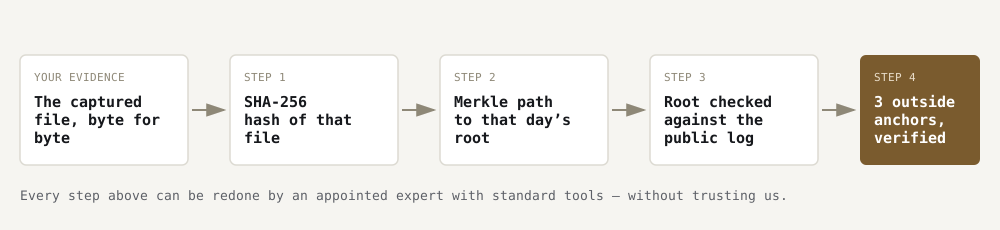
What sealed means here
This block is the same on every page of this site, and it is repeated on purpose: it is the part you need in order to judge everything else.
- One fingerprint for the whole day. Every observation made that day, yours among hundreds of thousands, is reduced to a single hash through a Merkle tree. One changed byte anywhere in that day, and the fingerprint no longer matches. There is no version that could be quietly corrected.
- Published where anyone can see it. The fingerprint goes into the public log the same night, under a fixed, citable URL, together with the instructions for recomputing it.
- Handed out of the house three times on the same day. An RFC 3161 time-stamp service, a decentralised OpenTimestamps anchor in the Bitcoin blockchain, and a qualified eIDAS time-stamp from GLOBALTRUST (e-commerce monitoring GmbH, Austria), a qualified trust service provider listed on the EU Trusted List. The third of these is paid for and supervised, and it is worth saying so plainly: only the qualified time-stamp carries the presumption laid down in Article 41(2) eIDAS. A free anchor establishes that the data existed and has not changed, but it carries no presumption laid down by law.
- Twice over, by two witnesses that cannot write to each other. Two machines at two providers in two countries, with separate keys. Each seals its own day and takes its own anchors.
In plain words, two sentences. We cannot change a byte afterwards, because the day's fingerprint would no longer match. And we cannot backdate one, because that fingerprint has been in other people's hands since the night it was made. No one has to believe us: every step can be repeated with standard tools.
Further: how it works · what we store · glossary.
Does this stand up in court?
We cannot promise that, and nobody can promise it honestly: what a court accepts is for the court to decide. What we can tell you is what the document is made of, and each of the four facts below can be checked before you buy anything.
- It comes from a third party, not from you. Not your screenshot, not your server log. The bytes were fetched and stored by a third party that did not know your matter existed, on a day chosen by the calendar and not by the case. That is the difference between a record and an account of events.
- A presumption laid down by law. Every sealed day since 31 July 2026 carries a qualified electronic time-stamp from a qualified trust service provider on the EU Trusted List. Under Article 41(2) of Regulation (EU) No 910/2014 (eIDAS), such a time-stamp enjoys a presumption of the accuracy of the date and time it indicates and of the integrity of the data it is linked to. Article 41(1) says something much narrower, namely that a time-stamp may not be denied legal effect merely because it is electronic. The two paragraphs are routinely confused; the one that matters here is the second.
- Two independent witnesses. Two machines, two providers, two countries, separate keys. Each one seals its own day and anchors it externally on its own. Neither can write to the other, so neither can be corrected to match the other after the fact.
- Verifiable without us. An appointed expert repeats every step with standard tools: recompute the hash of the file, rebuild the path from that hash to the day's root, check the root against the public log and against the external anchors. We do not have to be believed, and that is the point of the whole construction.
What follows from this in your particular matter is for your lawyer to say. We do not advise, do not rate and do not take a side, and the other side can order the same document on the same published terms. That is not a weakness of the document. It is the reason it is worth anything.
How to order
- Online, with the form below: name the domains, choose yearly or monthly, and continue to the payment page. Billing address and VAT number are entered there, and VAT is applied as the law requires. We do not ask what the matter is.
- Or by e-mail to contact@machinewitness.eu, if you would rather have the fee confirmed in writing first. Name the domains (and the subpages, if you want the add-on), yearly or monthly, and your billing address with a VAT number if you have one. You receive the confirmation and a payment link.
- After payment you receive a confirmation with your reference straight away; the invoice follows separately.
- The admission is entered, with its date, in the public record, within five working days of payment.
- The subscription renews for the same period until you end it. You end it yourself, through the link in the confirmation; the end takes effect at the end of the period already paid.
We answer in German, English or Spanish.
Fee
150 € per domain and year, or 15 € monthly, paid in advance, as set out in the fee table. From the 21st domain in the same subscription, each further domain costs 50 € a year, or 5 € monthly: 20 domains cost 3,000 € a year, 100 domains 7,000 €. The tier is published and the same for everyone. A domain that is already observed in the core is not charged.
When the subscription ends. Everything recorded until then stays in this archive and in the sealed days for good; nothing is withdrawn, and an extract of those days can still be ordered at any time. From then on the domain is recorded like every other domain in the broad set: its machine-readable files and the head of its homepage daily, the full homepage weekly.
Form of the result
The admission itself: a dated entry in the public record of admissions, on both witnesses, checkable at any time through the coverage check. There is no document at this stage, because the document is the extract drawn later from the days that were recorded.
What you hold when you need it
The observation itself produces no document: you pay for the days being recorded. The day you need them, you order an extract, and this is what it looks like. The sample below is a real extract of our own domain, machinewitness.eu, which is observed every day like every domain in the core: three days, every file, both witnesses.
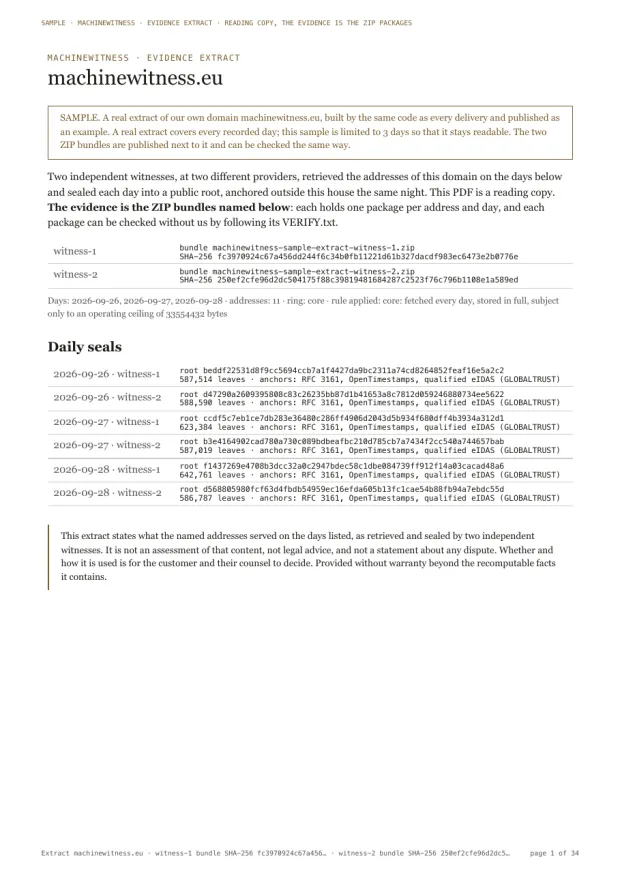
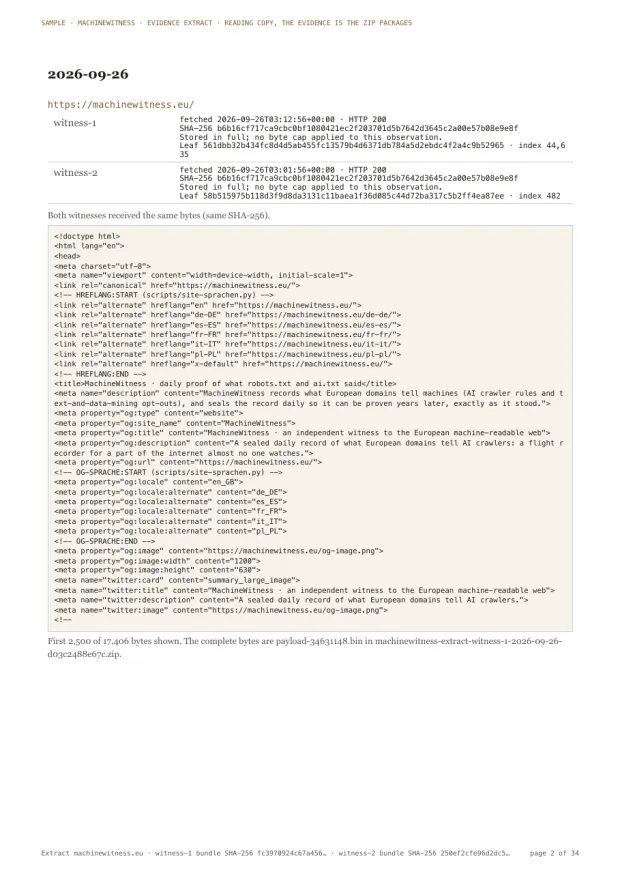
- Sample extract, PDF (0.4 MB, 34 pages)
- The extract explained, with both bundles to download
- The entry of a domain in the public record: check any domain, including ours
The method sheet is included. Every extract comes with the general method sheet at no extra charge, including the one covering a single day. It describes how this archive observes, seals and anchors, and it carries a version and a date. It is not written for your matter, and it does not have to be: it is the same for everyone, which is precisely what makes it checkable.
The technical procedure statement is a different document, written for this particular observation, signed and addressed to a court or an appointed expert. You do not need it in order to file the extract. It becomes relevant when the other side disputes the method rather than the content. See the fee table.
What becomes public, and what does not
Visible to anyone
- that the domain or URL is observed, and from which date
- the dated entry in the public record of admissions
- the daily roots and anchors, as for every other observation
Never published
- who applied, in no document
- why: we do not ask what the matter is
- what the files said: content is issued only as an extract, at the published fee, to anyone
The other side can see that the URL is observed, and since when. That is the price of a witness that belongs to no party, and it belongs here, before the purchase, not in the small print. Where a look-alike domain is observed as a precaution, an opponent may infer that someone is preparing. Whoever does not want that orders a record of a single day instead of a standing observation.
Neutrality. This archive records; it does not rate, rank or advise. Three conditions hold for everything on this page: it is visible to everyone in the same way; the fee is published and depends neither on who asks nor on how a matter ends; and whoever pays receives nothing a third party would not also receive, which means no notification, no mention as the applicant, no priority, and no content without an extract that anyone else could order too.
Further reading: how it works · evidence extract · terms, section 5.